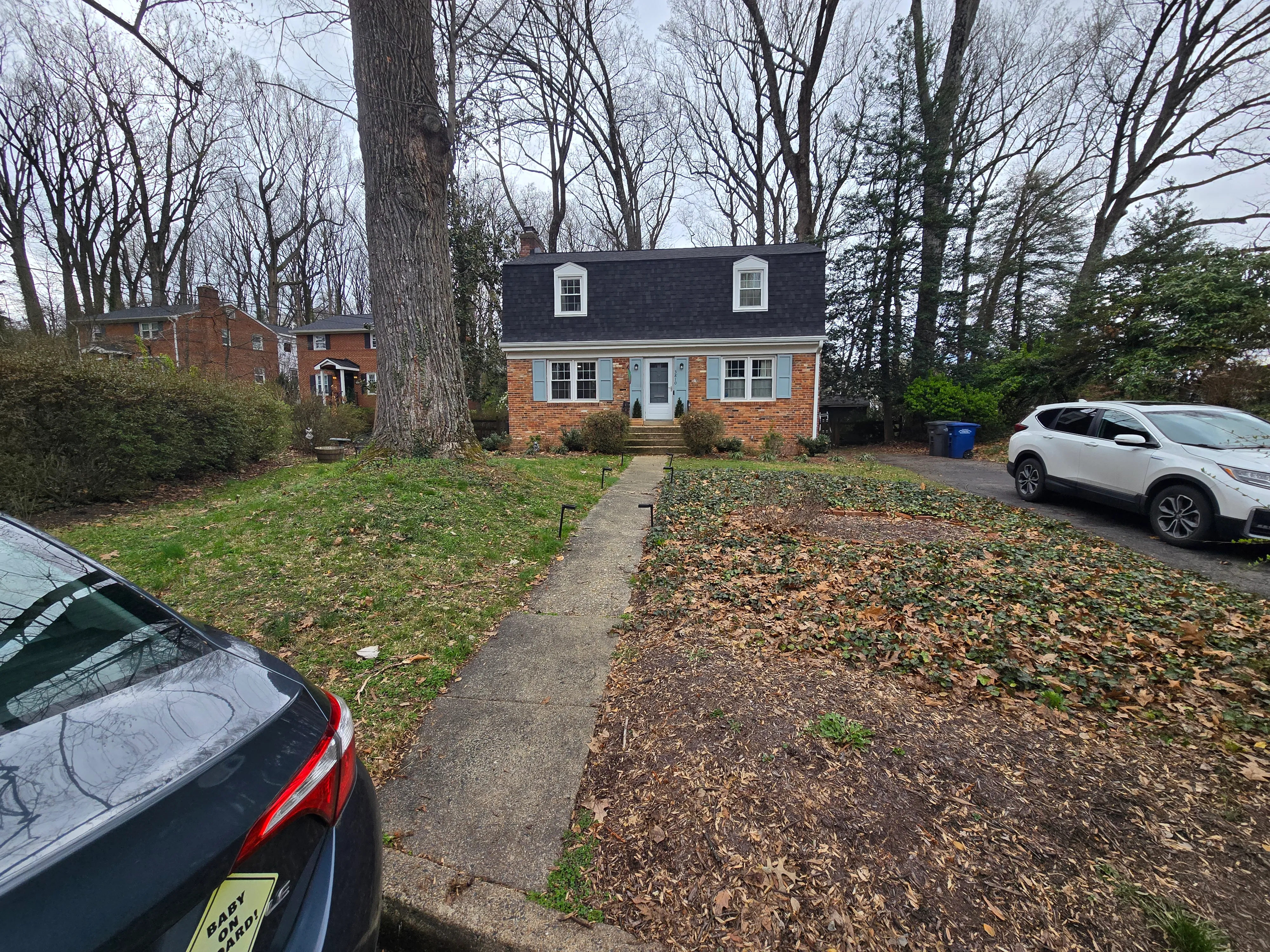
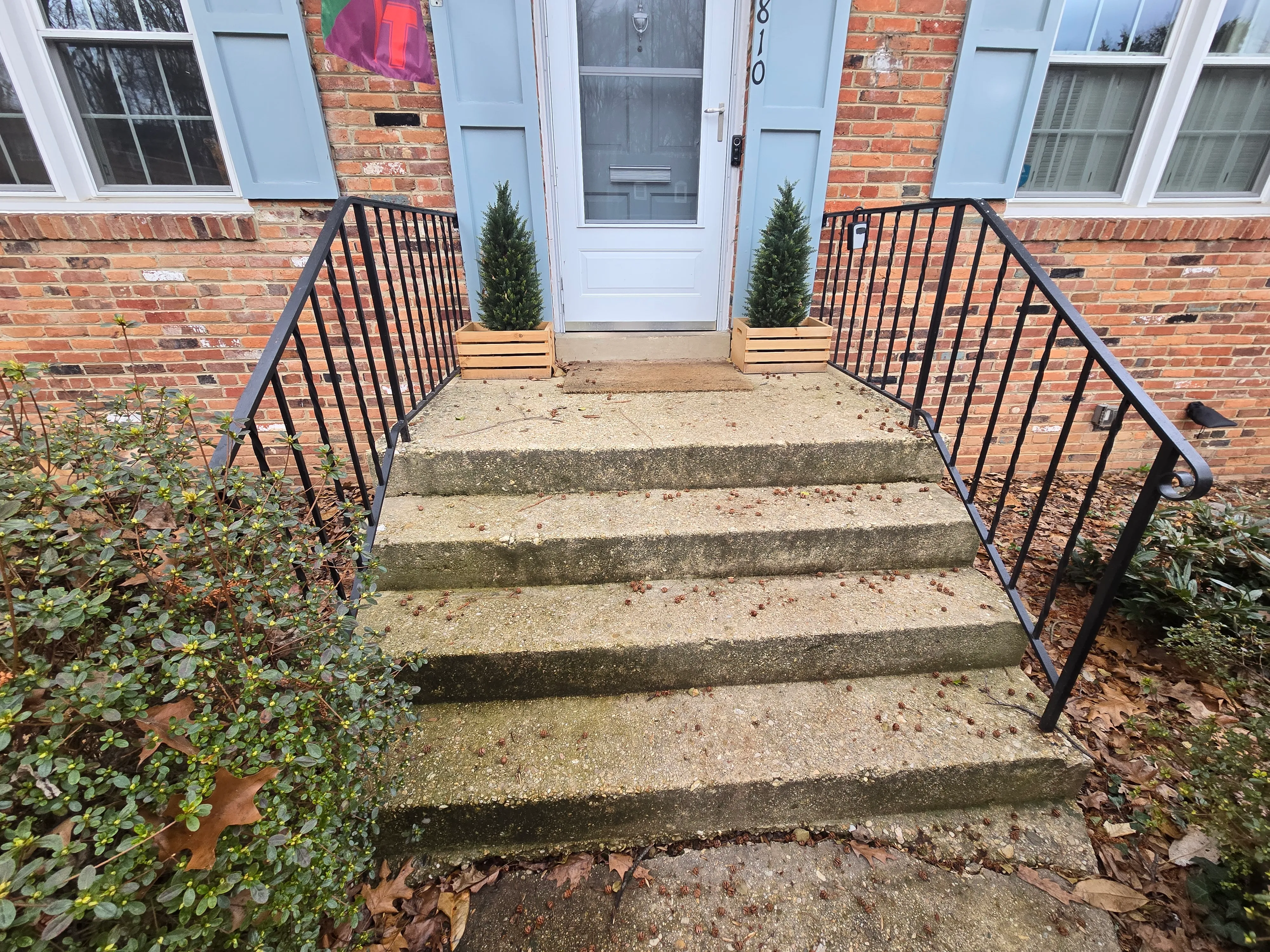
Additional Before Views — Surface Detail
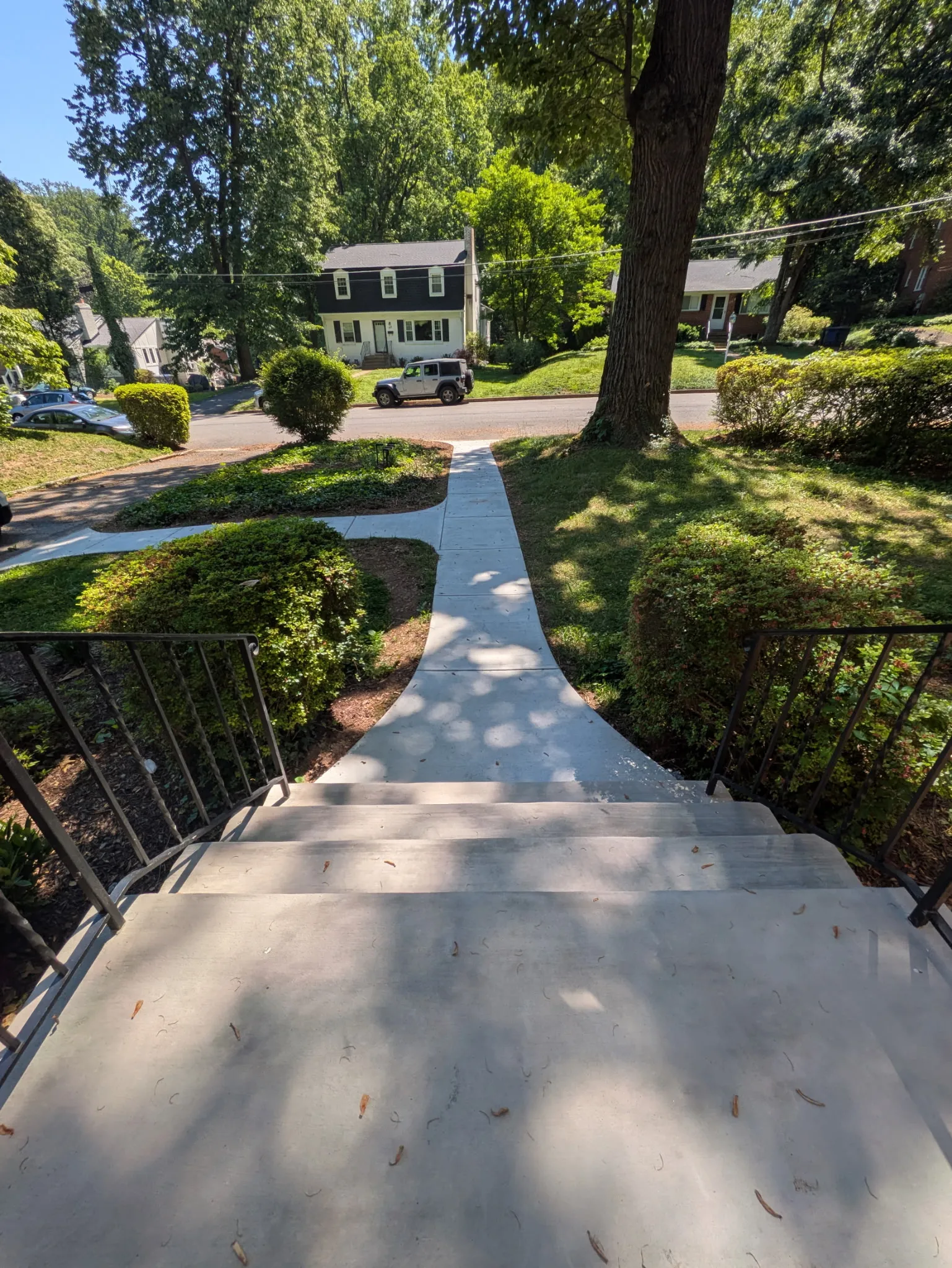
Walkways and front porches built or restored in concrete, paver, flagstone, brick, natural stone, and stone veneer overlays.
Front-entry walkways, side paths, porches, and step junctions across Northern Virginia — whether you need a new walkway poured, an aging concrete porch resurfaced, worn front steps repaired, or a tired entryway restored with a stone veneer overlay. Your walkway and porch are the first things visitors and prospective buyers see, so they set the architectural tone of the home and carry every guest from the street to the front door year-round. We install new walkways and porches in concrete, paver, flagstone, brick, and natural stone over a compacted floating gravel base adapted to the underlying NoVA soil density, and we restore existing porches and walkways with concrete resurfacing or full mortared stone veneer overlays — delivering a high-end look without the cost and disruption of full demolition.
Our Process
A straightforward, five-step process — no high-pressure sales, no hidden costs, no surprise change orders.
We come to your home, measure, listen to what you want, and answer questions in person — at no cost and no obligation.
Within 48 hours you get an itemized written quote covering materials, labor, timeline, and warranty terms. No surprise upcharges later.
Materials are sourced from Northern Virginia suppliers, prepped to spec, and delivered to the job site on schedule.
Our crew installs to spec, on schedule, with daily site clean-up. Most projects are completed in 1–3 days on-site.
We walk every job with you before final payment. All workmanship is backed by a written warranty.
Your walkway, front porch, and entry steps are the first thing visitors and prospective buyers see — together they set the architectural tone of the home. We pick materials that complement the architecture and the existing front-yard hardscape: historic brick for a colonial, broad bluestone slabs for a craftsman porch, large-format concrete pavers for a modern build, or stone veneer overlays to restore a tired concrete porch into a high-end natural-stone entry without the cost of full demolition. Width and material selection follow function, not the cheapest pull from a contractor catalog.
Walkways carry people from the street or driveway to the front door year-round — in rain, snow, and ice. Porches and step landings are where people pause, set down bags, and gather. The contractor industry sells walkways by a flat width minimum and porches by builder-grade dimensions; we engineer them around how the space actually gets used. Transit segments (where people simply move through) work well at 3 to 4 feet of clear width sized to the property's lot lines, planting beds, slope, and existing trees. Landing pads — front door, porches, step junctions, gathering points — work well at 5 to 6 feet, or larger if the architecture allows. We engineer for safe transit and safe entry: less than 1/4-inch lippage between adjacent units, a textured (non-polished) surface finish, slope under 1:20 (5%) on transit runs, and integrated handrails where steps and slope demand them. We avoid materials that get slick when wet — polished travertine and smooth troweled concrete are out for front walks and porch surfaces.
If your existing concrete walkway or porch is structurally sound but cosmetically tired — surface spalling, faded color, dated broom finish — a full mortared stone veneer overlay restores it to a high-end natural-stone entry without the cost, disruption, and waste of demolishing the substrate. We bond thin-cut natural stone or full-bed dimensional stone (flagstone, slate, fieldstone, cut limestone) directly to the existing concrete with a polymer-modified mortar bed, joint and point with traditional masonry mortar, and seal as required by the stone choice. The result is a permanent stone surface — not a thin-set tile — that handles freeze/thaw, foot traffic, and snow shovels the same way a poured-stone porch would. Veneer overlays are the right call when the existing concrete is sound, the slope is correct, and you want to upgrade the appearance without replacing the substrate.
Front steps take the worst beating on the house — the most concentrated freeze/thaw exposure on the property, salt-loaded every winter, hit by every visitor every day. Spalled tread surfaces, hairline cracks at risers, separated step-to-porch joints, and worn-down nosing edges are the usual failure pattern. We restore failing steps with a layered approach: structural repair first (epoxy injection on hairline cracks, mortar patching on spalled corners, full re-cap on heavily worn treads), then aesthetic resurface (concrete overlay, stamped overlay, or stone veneer cap depending on the rest of the entryway). For full entryway restorations — steps, porch, and adjoining walkway done together — we sequence the work so the finish materials match across all three zones for a unified result.
New walkways and porches get the same proper floating base as a driveway, sized to the lighter traffic loads of pedestrian use: excavate to firm subgrade and compact gravel in precise 2-inch lifts, building up to a 4-to-5 inch total depth. The compaction is adapted to the underlying NoVA soil density to prevent shifting and settling — looser fill needs more passes than dense subgrade. For poured-concrete walkways and porches, we pour a standard 4-inch slab of 3000 PSI air-entrained concrete engineered specifically for foot traffic — deliberately lighter and more cost-effective than the 4000 PSI vehicle-rated mix we pour under driveways. Paver walkways and porches set directly on the floating base with a thin sand bedding course.
The walkway and porch must shed water away from the house foundation — not channel it toward it. Standing water against the foundation is the number-one source of basement leaks in NoVA. We grade every walkway and porch with minimum 1/4 inch per foot of cross-slope away from the foundation wall. Where the walkway runs perpendicular to the house, the slope runs along its length toward the yard or driveway. Porches grade toward the open side, away from the house wall. Drainage planning happens at the estimate visit, before any base material goes in.
A new pour is right when there's no existing walkway or porch, when the existing one has heaved or sunken to the point of being a tripping hazard, when the substrate has failed structurally, or when the dimensions need to change. A concrete resurface (color-matched overlay) is right when the substrate is sound but the surface is spalled, faded, or has minor cracks — fastest, lowest cost. A stone veneer overlay is right when the substrate is sound, the surface is structurally fine, and you want to dramatically upgrade the appearance to high-end natural stone without replacing the slab underneath. We walk through which path makes sense at the estimate, based on what we see on site rather than what produces the biggest invoice.
Project Gallery
Real before-and-after photos from homes we've worked on.
Additional Before Views — Surface Detail
Common questions from Northern Virginia homeowners about walkways & porches projects.
Width should be engineered around function, not picked as a flat industry rule. Transit segments (where people just move through) work well at 3 to 4 feet of clear width sized to the property's lot lines, planting beds, and existing trees. Landing pads — front door, porches, step junctions, gathering points — work well at 5 to 6 feet. The right walkway combines both zones, transitioning cleanly between them, sized to your lot's actual constraints rather than to an arbitrary minimum.
Transit walkways should slope under 1:20 (5%) wherever possible for ADA-compliant accessibility and safe winter footing. Steeper sections (up to 1:12 max) require integrated handrails for safety. Porches grade close to flat for a stable standing surface but still carry a minimum 1/4 inch per foot of cross-slope away from the house to shed rainwater. Cross-slope on walkways is also minimum 1/4 inch per foot — enough to shed water, not enough to feel tilted underfoot.
Yes — provided the existing concrete is structurally sound (no major heaving or settling), the surface is reasonably level, and the slope is already grading water away from the house. A full mortared stone veneer overlay bonds directly to the existing slab and delivers a permanent natural-stone porch surface. The trade-off is that the porch elevation increases by the stone thickness (typically 1 to 2 inches), which affects how the porch meets the door threshold and the top step. We assess all of this at the estimate visit before committing to overlay vs. tear-out.
Usually no. Most front-step damage we see is surface-only: spalled treads, chipped nose edges, separated step-to-porch joints. We restore these with a layered repair — structural patching and mortar work first, then a finish resurface (concrete overlay, stamped overlay, or stone veneer cap) depending on the look you want for the entryway. Full replacement is only required when the steps are structurally failing (cracked risers, settled treads pulling away from the porch, heaving from a failed sub-base).
Every project is unique based on length, width, your material choice (poured concrete, paver, flagstone over concrete, brick, natural stone, or stone veneer overlay), whether the work is a new install, a resurface, or a veneer overlay, base-prep needs, and demo of any existing surfaces. We provide fast, accurate, on-site estimates so you know exactly what to expect before we begin.
Absolutely. We know every homeowner has a specific budget. We will walk you through different material choices—from standard brushed concrete to custom flagstone—to find the exact right fit for your home and your wallet, delivering exceptional durability at a fair price.
Available to homeowners throughout all four Northern Virginia counties we cover.
Why Northern Virginia Homeowners Choose Us
Marc Matthews and Stephen America — two Reston natives — founded American Railing & Masonry on a single non-negotiable standard: value exceeds expectations on every job. We are a 100% fully insured local contractor serving Fairfax, Loudoun, Prince William, Arlington counties — no franchise pricing, no middleman, no compromise on craftsmanship.
A budget-friendly alternative to full replacement that makes your old concrete look brand new.
Smooth, durable finishes that instantly elevate the front of your home at a fair price.
Eco-friendly driveway solutions that look great and manage water effectively.
Budget-friendly, low-maintenance outdoor living spaces.